Mar 07 - New 'Forex Blog' feed email from feed2email.net

Hi there!
Here's the latest feed from Forex Blog.

Add feeds@feed2email.net to your contact list to make sure you receive all your emails
Make sure to visit feed2email.net to get more feeds sent to your inbox.
To find out which feeds you are subscribed to, or to get further help, just reply to this email.


Emerging Markets (Asia) Bow to Inflationary Pressures: Currency Appreciation will Follow

Mar 07, 5:25AM

I ended my previous post on the subject by noting that emerging market Central Banks were at a crossroads. Either they would raise interest rates and accept currency appreciation, or they would risk hyperinflation and economic instability. While the jury is still out on a handful of cases, it looks like most of the emerging [...]


Oil Prices and the FX Conundrum

Mar 05, 6:07AM

I haven’t blogged about oil prices in quite some time. After prices collapsed in the wake of the financial crisis, there really wasn’t much to talk about. However, the price of crude oil has risen more than 50% since June, and it now seems to be at the forefront of investor consciousness. Currency market watchers, [...]


Competition Heats Up in Retail Forex

Feb 27, 3:15AM

The last few weeks have witnessed a number of major developments in the retail forex world: more mainstream firms  entering the fold, and existing firms are moving to beef up their forex operations. Not only will this permanently alter the competitive landscape, but it should also benefit traders in the form of more choice, lower [...]


Untangling the Puzzle of Risk Appetite

Feb 24, 5:49PM

When analyzing forex, nothing is more satisfying than establishing a strong correlation between a particular currency pair and another quantifiable investment vehicle. You see – we fundamental analysts love to kid ourselves that we can actually explain what’s going in the forex markets, but it’s only when you can visually observe (and statistically confirm) a [...]


Chinese Yuan: Further Appreciation is Inevitable

Feb 22, 4:47PM

Relatively speaking, the Chinese Yuan has been on a tear, appreciating ~1% in a little more than a month. One has to wonder whether this is a concession by the People’s Bank of China (PBOC) that its exchange rate regime is not viable or whether its instead a political sop. The question on everyone’s minds, [...]


EU Ponders Tobin Tax

Feb 20, 3:21PM

Only two years after the worst financial crisis in decades, the DJIA is now back above 12,000. Yield-hungry investors are pouring record amounts of cash into emerging markets. Commodities and food prices are rising into bubble territory. In fact, not a single meaningful reform has yet to be passed that would prevent such an event [...]


The Obama Budget and the Dollar

Feb 18, 5:50AM

Last week, the Obama Administration released its fiscal 2012 budget to much fanfare. Unfortunately, the budget makes only a token effort to address the rising National debt, and forecasts a budget deficit of $1.1 Trillion. While the release of the budget failed to make a splash in currency markets, traders would be wise to understand [...]


Hedging High Forex Uncertainty

Feb 15, 11:17AM

In forex, everything is relative. That is no less the case for forex volatility, which is low relative to the spikes in 2008 (credit crisis) and 2010 (EU Sovereign debt crisis), but high relative to the preceding 5+ years of stability. On the one hand, volatility is approaching a two year low. On the other [...]


Forex Markets Look to Interest Rates for Guidance

Feb 11, 10:38AM

There are a number of forces currently competing for control of forex markets: the ebb and flow of risk appetite, Central Bank currency intervention, comparative economic growth differentials, and numerous technical factors. Soon, traders will have to add one more item to their list of must-watch variables: interest rates. Interest rates around the world remain [...]


CFTC / NFA Enhance Regulation of Forex

Feb 08, 2:04PM

In 2010, the US Commodity Future Trading Commission (CFTC) formally released a series of new regulations governing all retail foreign exchange dealers. Having given all applicable firms almost six months to bring their operations up to speed with the new regulations, the CFTC is now moving to bring enforcement actions against those that are still [...]


If at any time you'd like to stop receiving these messages, just send an email to www_forexblog_org_feed+unsubscribe-gtforexsystem=gmail.com@mail.feed2email.net.
To stop all future emails from feed2email.net you can reply to this email with STOP in the subject line. Thanks

Forex Blog

Forex Blog


Emerging Markets (Asia) Bow to Inflationary Pressures: Currency Appreciation will Follow

Posted: 06 Mar 2011 09:25 PM PST

I ended my previous post on the subject by noting that emerging market Central Banks were at a crossroads. Either they would raise interest rates and accept currency appreciation, or they would risk hyperinflation and economic instability. While the jury is still out on a handful of cases, it looks like most of the emerging market countries in Asia have chosen the former.

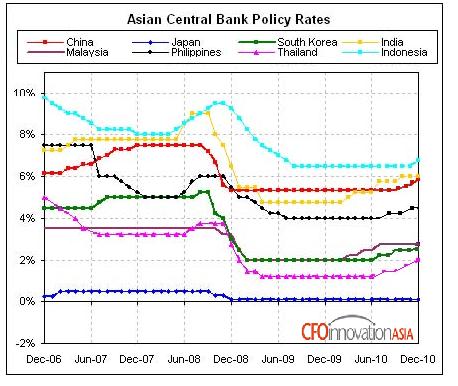
In February, the Bank of Indonesia raised its benchmark interest rate to 6.75%, from a record low of 6.5%. The People’s Bank of China (PBOC) has now hiked rates three times in the current tightening cycle. After a hike in January, the Bank of Korea inscrutably decided to hold rates in February, but signaled that another rate hike in March is likely. The Central Bank of The Philippines similarly indicated that it is ready to embark on a program of tightening. The same goes for the Reserve Bank of India (RBI). So far the main holdout is the Bank of Thailand, whose interest rates are still the lowest in Asia (ex-Japan) and remains reluctant to raise them too quickly.

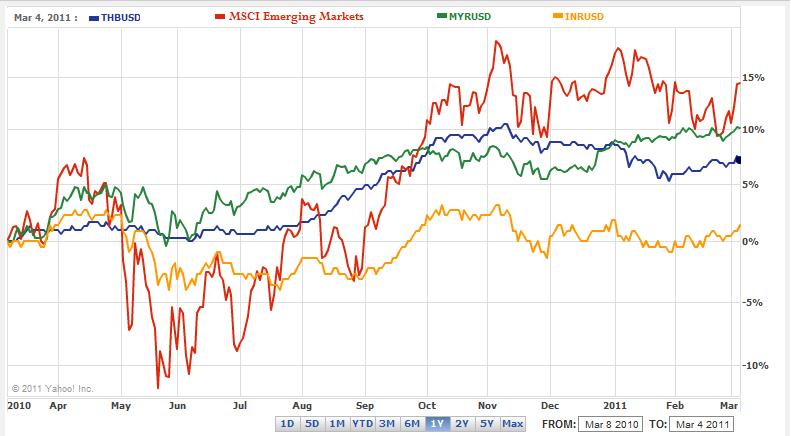
Towards the end of January and the beginning of February, most Asian EM currencies sputtered in their appreciation. While there were a number of reasons for this (notably a pickup in risk aversion), Central Banks rejoiced in their perceived victory of foreign currency speculators. Unfortunately, there were a few downsides to this. First of all, capital outflow produced marked declines in Asian stock and bond markets, raising borrowing rates for everyone making it more difficult for domestic firms to raise capital. Meanwhile, inflation continued to rise, with no signs of slowing.

Thus, as I remarked the last time around, it was inevitable that (Asian) Central Banks would inevitably come to their senses. First of all, they realized that there was no free lunch, and that controlling their currencies would disable them from using traditional monetary policy tools to fight inflation. Second, while they could do without currency appreciation, they realized that this would have to be tolerated if they wanted to continue attracting foreign investment. (That’s because, as the Financial Times pointed out, currency appreciation probably accounts for half of all emerging market investment returns).

Third, it is inevitable that emerging market currencies will continue to rise over the long-term, in line with productivity gains. According to the Balassa-Samuelson effect, “countries with above average real income growth should have rising price levels, relative to other economies, and strengthening real exchange rates.” Based on this notion, emerging market currencies are forecast to rise by an average of 1.7% per year for the next 10 years.

Finally, in accordance with the unofficial rules of the currency war, emerging market countries are competing not with industrialized countries, but with each other. If all of their currencies rise in unison, export competitiveness is unaffected, inflation is tamed, and foreign capital remains abundant. It would seem to be a win/win/win.

In fact, it seems like investors are less interested in distinguishing between the different emerging market currencies of Asia, since at this point, all of them offer similar currency appreciation (over the last six months, returns have converged) and similar inflation-adjusted carry. Thus, it stands to reason that as Asian Central Banks continue to tighten interest rates, their currencies will continue to rise together.

SocialTwist Tell-a-Friend

Percentage in Point

Percentage in Point


Hedging In Forex Markets

Posted: 06 Mar 2011 06:00 AM PST

Hedging is defined as making an investment to minimize the risk of adverse price fluctuations in an asset. Actually investors use this tool whenever they are not sure about the market’s upcoming events.

Similarly, in Forex market, Forex hedging takes place. Traders use this strategy to reduce the risk in trading. Although, Forex hedging cannot eliminate all the risk or other damages occurred in the market that causes to affect the trader's funds, but a proper hedging is likely to minimize the negative effects on those stocks.

Following are some important points that should be kept in mind while using hedging.

Which Currency Pair Protects Which Type Of Risk?

Basically there are two types of risk, i.e. downside risk and upside risk. When you are long in currency pair, you can use hedging to protect yourself from downside risk. On the other hand, if you are short in currency pair, then you can use hedging to protect yourself from upside risk.

The Easiest Method To Implement Hedging

A simple and easy way to for implementing a hedging strategy would be to make a transaction which involves another currency. Definitely, this currency will have a negative relationship with currency you used in the first transaction. For instance, you are using a currency pair USD and Euro. So if you are going long in USD, and an event in the world leads to either USD or Euro increasing, with other the other currency falling, then you can protect yourself by going long on Euro. So in this way, it does not matter which currency increases, you will make the profit.

The experienced traders know better the usage of hedging. For them, hedging can really reduce the losses, but there are some risks involved in hedging which should be considered before getting started the hedging. They are described next.

Hedging Comes At A Price

You should remember that hedging is not free of charges. Whether you needed them or not, you will have to pay for the hedges. Therefore, you need to make sure yourself that hedges are worth the money you are going to spend on them. You have to assure that the expected negative result will not happen. In case you cannot justify the money you are going to spend on the hedge, then you should not hedge your primary investment.

Forex Hedging In Itself Does Not Make Money

The important characteristic of hedging is that it does not make money in itself. Rather, hedging can help protect your funds from adverse and unexpected events that could cause the loss of your primary investment. So you should make it sure that hedge will protect you from such unhappy circumstances. The traders who are not experienced or do not know much about Forex hedging may think that they are protected to a high extent by a hedge they execute. After an unexpected or adverse event, they should find out that the hedge did not protect them as they expected. It can result not only a big loss from the primary investment, but also the cost of the hedge will be paid by the traders.

People who liked this Post also read

  • Usage Of Candlesticks Chart in Forex Trading
    If you are looking to invest in the forex market, make sure you use the best method to predict the prices and the best method is the Candlestick chart. Do a short, medium and long term analysis of a stock's price and then make your move....
  • Online Forex Trading For Bigenners
    Online forex trading is one of the complex businesses, especially for the beginners. However, there are some tips which could help beginners learn the business. That is, to open a demo account first, get forex education, take robot training programs in ad...
  • Forex trading course on DVD
    The main purpose of Forex Trading is to support international trade among the countries and allow investments for the businesses to convert one currency to another. Due to this you can also make a good relation with other countries. ...
  • Forex Margin Call : Basics
    Margin Call is a situation which arises when you are running low on funds in your accounts. Your broker at this situation would get in touch and would ask you to increase your balance so that you can further pile up on stock. The situation for being on a ...
  • Forex Market Terminology
    Once start trading at the Forex market, you have to become used to with the huge amount of information. It is difficult for a new trader to learn the jargons. Few terms used in currency exchange are easy to understand, whereas others are not. So it is imp...


Forex Crunch GBP/USD Outlook – March 7-11

Forex Crunch GBP/USD Outlook – March 7-11


GBP/USD Outlook – March 7-11

Posted: 05 Mar 2011 11:57 PM PST

After a busy week that saw a false breakout, cable traders await another tense one, with the rate decision being the highlight. Here’s an outlook for the British events, and an updated technical analysis for GBP/USD. While the manufacturing and services sectors are picking up after a temporary fall, the all-important services sector is still

AUD/USD Outlook – March 7-11

Posted: 05 Mar 2011 02:00 PM PST

After we’ve seen signs of strength from the Australian economy in the past week, Aussie traders await another busy one with employment figures being the highlight. Here’s an outlook for the Australian events and an updated technical analysis for AUD/USD. The Australian economy grew at a stronger pace than expected in Q4 – 0.7%. Together

EUR/USD Outlook – March 7-11

Posted: 05 Mar 2011 10:00 AM PST

After we got the biggest hint for a European rate hike, another busy week is expecting Euro/Dollar traders. Here’s an outlook for the European events, and an updated technical analysis for EUR/USD. Jean-Claude Trichet used the code words “strong vigilance” and even went one step further in saying that a rate hike in April sure

Forex Binary Options March 7-11

Posted: 05 Mar 2011 05:40 AM PST

Many news events are scheduled this week, and they provide opportunities for trading binary options on currencies – an alternative to traditional forex trading. Here are the setups for the upcoming week. Binary options can be utilized to defend against false breakouts, as another way of doing a stop loss and for news events of

Percentage in Point

Percentage in Point


Forex trading course on DVD

Posted: 05 Mar 2011 10:00 AM PST

The foreign exchange market or the Forex trading is a world wide financial market for trading of currencies. Many buyers and sellers around the clock are doing transactions of different currencies. The foreign exchange market tells us the relative values of different currencies. Forex Trade supports the international trade.

Forex trading course on DVD

"There are many journals, books, magazines ,articles on Forex trading is present in internet but a Forex trading course on DVD will be preferred more because it has many dynamic elements and vast knowledge it presents over a conventional education". It will make easier for you if you want to search any related topic regarding Forex trading .You can search any of the related thing from the search box, which can be beneficial for the user. It will also provide the direct access to the seasoned traders and educators who are working hand in hand with you to understand the lessons. You will also get the feedback on your performance through out the course. It will give you unique and interactive learning environment and you will learn the things according to your own understanding and speed to gain and retain the information.

An ideal Forex trading course on DVD has many things which are Introduction about the Forex market, Fundamental Analysis, Basics of Technical Analysis, Detailed Technical Trading strategies, Professional Risk Management techniques and many more. You can learn a lot of things from there and get benefit.

Key Feature of Forex Trading Works

Throughout the course you will receive thirty five written guides explaining everything about the Forex trading in detail. Personnel mentoring will be done by the experienced person of Forex trading who knows about different strategies and important points. He will deal with you in any problem which is faced by you and you can also take advices from him .You will get a direct phone number and you can ask questions, take help directly from the teams who are working on Forex trade. Another way to advance your knowledge more there is a website on which different experienced persons are available for discussing any problem regarding Forex trading.

Key Features of Forex Mentor

Forex mentor will guide you whole about the Forex trading. Three hours video of different seminars regarding tips of Forex trading. Twenty hours of interactive videos of market basics to peters winning strategy, all complete with charts and full explanation in detail. Books will be also given and an in depth detail of technical information on trading the strategy is given in it. The main things to learn in it are the basics of trade, predicting market trends, hedging, and chart patterns.

Key Features of Trading Mind

Before doing any thing you have to make you mind and it's the most important thing for starting any work. Different sessions are given on improving the trading disciplines. The important learning things are to maintain your focus, handle fears and emotions, maintaining discipline, reserving bad habits etc.

People who liked this Post also read

  • Usage Of Candlesticks Chart in Forex Trading
    If you are looking to invest in the forex market, make sure you use the best method to predict the prices and the best method is the Candlestick chart. Do a short, medium and long term analysis of a stock's price and then make your move....
  • Forex Market Terminology
    Once start trading at the Forex market, you have to become used to with the huge amount of information. It is difficult for a new trader to learn the jargons. Few terms used in currency exchange are easy to understand, whereas others are not. So it is imp...
  • Online Forex Trading For Bigenners
    Online forex trading is one of the complex businesses, especially for the beginners. However, there are some tips which could help beginners learn the business. That is, to open a demo account first, get forex education, take robot training programs in ad...
  • Forex Margin Call : Basics
    Margin Call is a situation which arises when you are running low on funds in your accounts. Your broker at this situation would get in touch and would ask you to increase your balance so that you can further pile up on stock. The situation for being on a ...
  • How To Do Forex?
    Forex one of the fastest growing market and a lot of financial and economic activities, surely have very huge amount of profits waiting to be exploited. No doubt there are enormous profits available but still there are lot of cautions to be considered.Exc...